When heritage changes: can we preserve a tradition without freezing it in time?
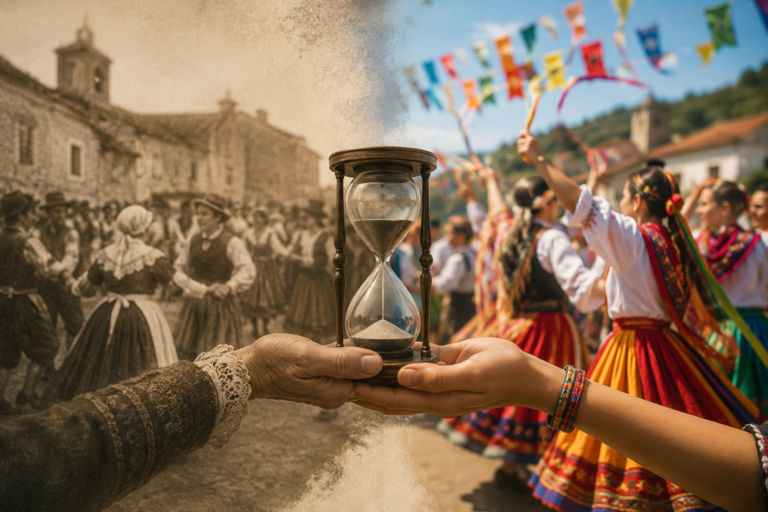
Is cultural heritage something static that should be preserved as it was, or something that naturally evolves with the people who inherit it?
This question was raised by most of the partners from the EYES project when developing their model heritage tours. Across different countries, traditions and local stories, all partners highlighted the importance of seeing cultural heritage as something alive, rather than as something frozen in the past.
And this matters because a tradition that never changes may actually stop being a living tradition. Nonetheless, traditions do not change for only one reason. They evolve as societies change, as people reinterpret them and as new generations find their own ways of engaging with the heritage they have received.
Traditions change because society changes
The communities that create and practise traditions do not remain the same. Gender roles evolve. Languages change. Religious practices may become less central to everyday life. Young people find new ways to participate, while migration brings new influences and perspectives.
But changing a tradition can be difficult, especially when it is surrounded by a strong sense of sacredness and ritual. Some traditions are powerful, precisely because they follow established rules, gestures, costumes, roles and scripts that have been passed down through generations. Changing one element can therefore feel like changing something fundamental.
As an example, the Carnival of Binche (Belgium) is deeply rooted in local folklore and community identity. Held every year during the three days before Ash Wednesday, its rituals, costumes, music and characters have been passed down through generations, with the Gille as one of its main symbols. This strong attachment to tradition can make change controversial: questions about who can participate, including greater participation by women in traditionally male roles, can challenge ideas of what is considered “authentic”. Yet the UNESCO, which recognises the carnival as living heritage, increasingly emphasises inclusivity and non-discrimination as key principles in safeguarding intangible cultural heritage. So how can traditions remain faithful to their roots while making room for a more inclusive future?
Mons faces a similar debate around its local folklore, “the Doudou”. Although the tradition has evolved with the introduction of two female characters (Cybèle and Poliade) into the very codified fight between Saint-Georges and the dragon in 2000–2001, some people argue that change has not gone far enough. In 2026, initiatives such as “Folklore inclusif” invited people to question and reinvent that folklore, including who gets to participate and what the folklore of the future could look like.
Traditions also change because people reinterpret them
Change does not necessarily mean abandoning a tradition. It can mean giving it new life.
A song can acquire new meanings as each generation makes it its own. “Bella Ciao” is a striking example of that. One version is associated with the “mondine”, the women who worked in the rice fields of northern Italy, while the version that became widely known after the Second World War was transformed into a symbol of the Italian Resistance and anti-fascism. Decades later, a new generation discovered the song through “Money Heist” (“La Casa de Papel”), where it became a symbol of freedom and rebellion. It has since continued to appear in protests and political movements around the world. The melody remained recognisable, but the stories and emotions attached to it continued to evolve.
The same can happen with festivals, crafts and food. A traditional craft can be used to create contemporary objects. A festival can welcome new participants. A traditional recipe can be adapted to new ingredients while retaining the techniques or memories associated with it.
This is what makes intangible cultural heritage living heritage. The UNESCO describes it as something inherited from previous generations but continuously changing, evolving and being recreated as it is transmitted to the next.
But where do we draw the line?
This is where the tension becomes central:
Preservation: “We need to keep it as it was.”
Evolution: “We need to let it change so people continue to live it and care for it.”
Neither position has an easy answer. Preserving traditions protects collective memory and gives communities a connection to their past. But refusing any change can make heritage feel distant from the people who are supposed to carry it into the future.
This balance was also present in the development of the EYES model tours. Partners had to think about how to present local heritage in a way that respects its history while making it accessible to people today. Inviting young people to explore and describe their local heritage through digital tours is one way of bringing traditional stories into contemporary formats and allowing them to live alongside the present.
Perhaps the question is therefore not whether heritage should change, but how we can allow it to evolve without losing what makes it meaningful.
After all, heritage is not simply something we inherit from the past. It is something communities continue to practise, reinterpret and pass on.
So, when we pass a tradition on to the next generation, are we preserving its past or helping to shape its future?
References
UNESCO. (n.d.). Carnival of Binche. Intangible Cultural Heritage. https://ich.unesco.org/en/RL/carnival-of-binche-00033
UNESCO. (n.d.). What is intangible cultural heritage? https://ich.unesco.org/en/what-is-intangible-heritage-00003
UNESCO. (n.d.). Frequently asked questions: Living heritage. https://ich.unesco.org/en/faq-01058
Ville de Mons. (n.d.). Cybèle et Poliade. https://www.mons.be/fr/doudou/ducasse-rituelle/combat-dit-lumecon/personnages/cybele-et-poliade
Mars – Mons Arts de la Scène. (2026). Ateliers « Folklore inclusif ». https://surmars.be/agenda/2026-04/rendez-vous/ateliers-du-temps-pour-demain-folklore-inclusif
The Guardian. (2024, October 11). Bella Ciao: The history and evolution of the resistance anthem. https://www.theguardian.com/world/2024/oct/11/bella-ciao-resistance-anthem-history-meps-strasbourg-viktor-orban